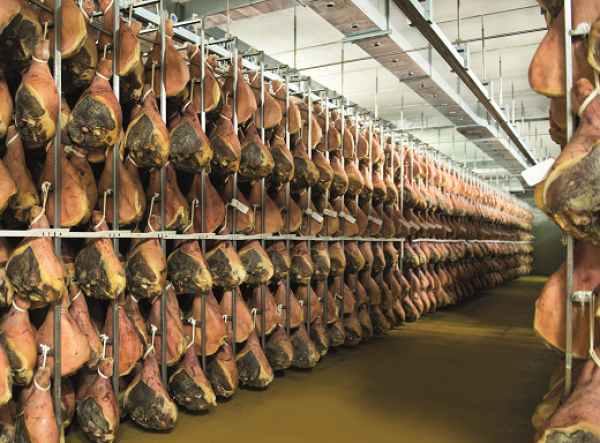
The Group experience on manufacturing Cured Hams has origin at the end of the '80s in Parma land, where the art of curing hams has ancient traditions and is main value for the country. Till from the beginning, the company is part of the Industries property of the family Fiandri, inserted inside the chain of processing fresh meat, expecially pork's legs. The base of the chain has the Company Fimar Carni SpA, active from 1982, selecting from the best european slaughterhouses the back-quarter side of the pigs for process the meats directed to the industries of cold cuts. Fimar Carni has moved on 2011 to the new factory in Castelvetro (MO), where holds 2 lines for sectioning, 2 lines for deboning, with the capability of 1.400 tons /week, a system for mechanical parting meat, and a freezing tunnel that operates at -40°C, 2 cells for mainteining freezed meats at -20°C, stowing till 7.200 pallets, and 4 cells for store fresh meats. Fimar Carni can ensure complete traceability of the meats processed, from 2013 has obtained the certification IFS v.6 and BRC v.7, and is licensed for export to Hong-Kong, Vietnam, Brasil and Canada. On 1997 in Marzolara di Calestano (Parma), has been constituted the Tino Prosciutti SpA.
After a while, a second branch called Tino 2 has been added, bringing the production to 18.000 Cured Hams per week. From 2009 the plant has obtained the certifications IFS v.6 and BRC v.7, and the license to export to Hong Kong, Japan and Brasil. On 2013, for increase the production rate, the Group has acquired a new Curing Factory named Katia Prosciutti, for add 20.000 more Hams weekly. On June 2014 has got operative a new area for curing, deboning, form and pack Cured Ham Brick (Prosciutto Crudo Mattonella), single and double, intended for slicing industries. On 2014, acquiring the Company D'Autore Food, allowed the Group to get in touch with the promising reality of the sliced cold cuts. On 2015 has been restored completely the hystorical factory Fimar in Felino (PR), producing traditional Salami, and Salami directed to industrial slicers. The opportunity to follow all the stages of the process, from the fresh quarter to the sliced finished product, guarantee the total control on the chain and ensure the quality.